Wednesday, February 22, 2017

Patios and Walks

We follow up today on two projects posted previously. One began as a renovation of space under a deck, and the other, a patio/walkway project begun in virtual reality.

As recounted in our previous post, we predominantly used beige stone as a soil anchor under the deck.

Since that post, however, we have installed a patio and added some border plantings.

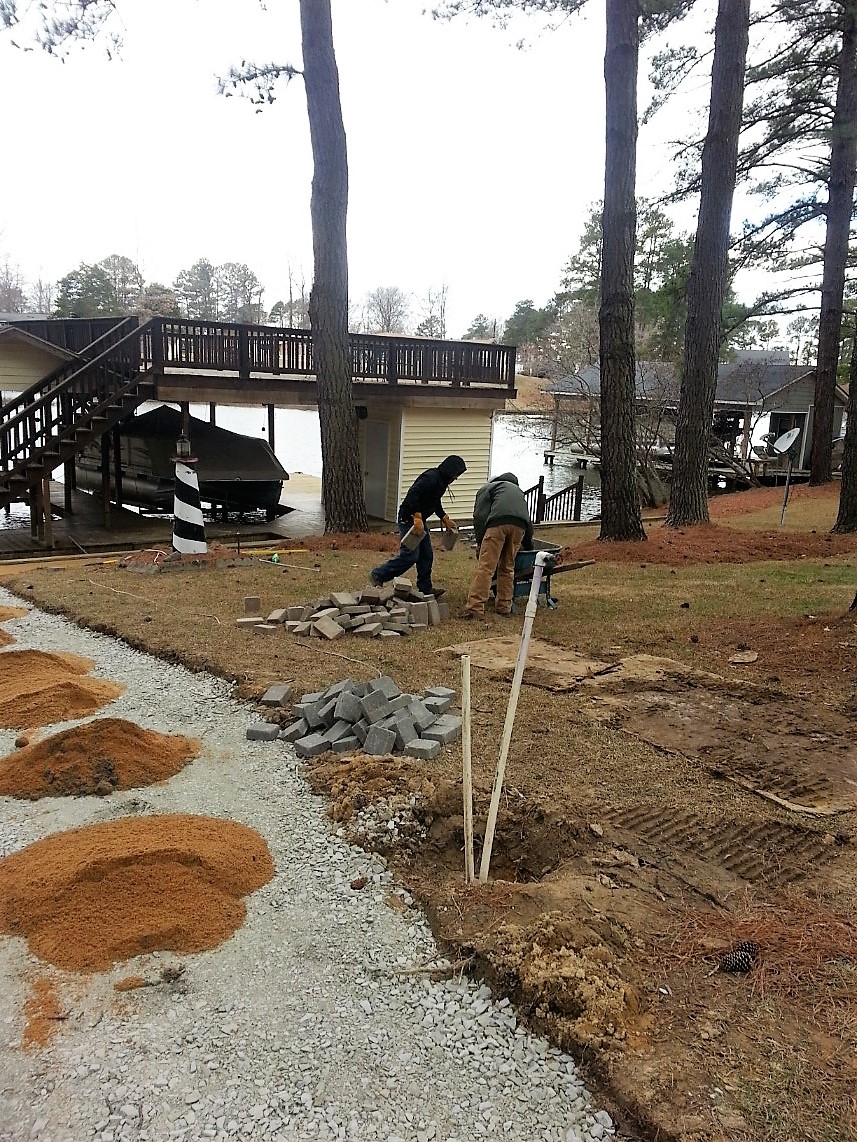
Then our guys turned their attention towards the Lake, and constructed a walkway and a new patio sitting area.


On the virtual reality front, although there is still plenty of work to do, the improvements are really starting to take shape. Notice how the actual installation differs in certain respects from the early virtual proposal. This was due to owner decisions and input, which we strongly encourage in all phases of our work.

Early virtual rendition of the proposed patio/walkway


Monday, February 13, 2017

At The Nursery

While many trees shed their leaves for winter, there are others that cling to their summer form despite the seasonal change. These are the evergreens, the non-deciduous varieties that keep their color all year round. Herewith a look at some of our favorite evergreens at the Nursery.

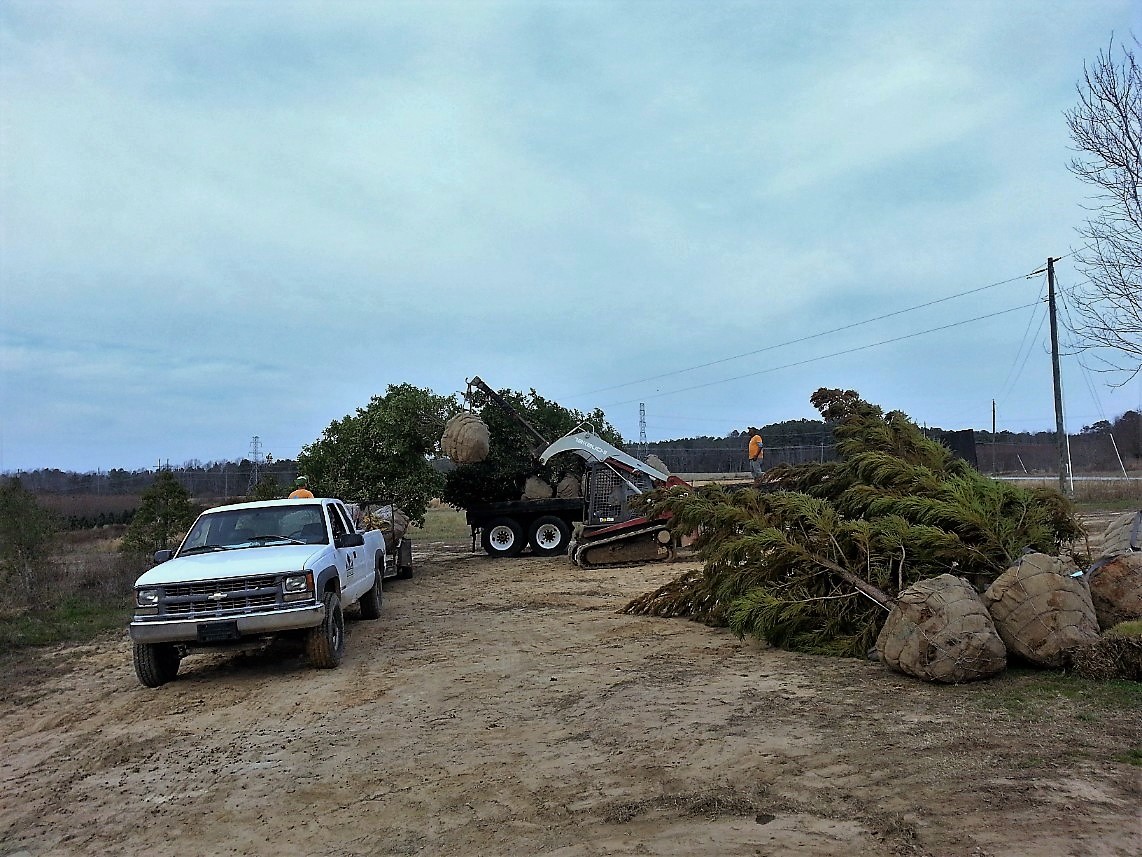
These are Green Giants. No, not the vegetable, but Green Giant Arborvitae, the evergreen. Technically, these are Thuja standishii x plicata 'Green Giant', for those that care about such things.

And 'Giant' is right. These currently stand some 10-12' high, and can grow to 50-60'. Green Giants will also grow fast, upwards of 2' per year.

Its rich, green, dense evergreen foliage plus fast growth makes the Green Giant an excellent selection for a screen or hedge. But its natural conical pyramidal growth habit and the way it will darken and bronze slightly in the winter means it can be a striking specimen, all by its lonesome. 

We also have some Japanese Cryptomeria (Cryptomeria japonica), which are currently larger than the Arborvitaes, some 12-14' high. Although not as dense as the Green Giants, Cryptomeria can be used as a screen, but its ornamental value is highly prized by many. In its native Japan, it is the national tree and used extensively around temples and shrines, and its dwarf variety enriches many a rock garden. 

To round out our survey of evergreens, we also have a few Leyland Cypress (x Cupressocyparis leylandii). And I mean very few, what's called in the trade 'limited quantities available.' But these are beautiful trees, and someone out there (hint, hint) will be quite fortunate to add one of these to their landscape plan.

Almost as we speak, our guys are loading some of these evergreens for shipment to points north and south, as these photos attest.


Friday, February 3, 2017

Virtual but Real

Here in the 21st Century, you got either virtual or you got real. At Ben's Creek Nursery, we do both!

It's all part of our design process. All hardscape installations involve form and function; there is an existing topography and landscaping that must be taken into account, and then there is the final function or utility that the customer desires. In our design process, we incorporate both into an initial proposal for the customer.

What is cool is that we can sometimes reduce the proposal to a graphical virtual reality superimposed on the customer's existing structures.


These plan/proposal renderings incorporate not only the design of the structures we will build, but also the specific types of material to be used. This way, the customer can get a truer sense of the look and feel of the final product.

And, these renderings enable the customer to virtually 'walk around' the proposed build. For instance, here is a picture of the patio addition from the perspective of the deck:

In this particular case, these 'walk around' views helped the customer decide to make changes to the initial proposal, eliminating the forward columns and grill and substituting a side walkway into the final proposal.

Once the proposal is approved, however, the big question is: how do you get from virtual to real? The answer is simple: it takes men, materials, and effort … lots of effort!

Following are photos of our crews engaged in the hard process of bringing the virtual into reality.


By next week we should have final photos of this installation. Stay tuned!

Wednesday, January 25, 2017

Shovel Ready

We love our decks at the Lake. But the space under them is often problematic: the shade retains wetness and moisture and makes it difficult to establish any kind of grass or plants. As a result, these areas often devolve into a sloppy clay look.

Enter Ben's Creek Nursery, with shovels ready and piles of natural beige stone to spread.


Judicious use of stone not only anchors the soil in wet conditions but provides a pleasing contrast with adjoining walkways and plantings.


Friday, January 20, 2017

Join Us!

We're hiring!

Here at Ben's Creek Nursery we are always looking ahead. Spring will be here before you know it, and that's when our maintenance work kicks into high gear. This includes lawn mowing, but also fertilization, yard clean up, fresh mulch, judicious pruning, and other common yard and garden maintenance work.

We are therefore looking to hire Landscape Maintenance Crew Leaders. Experience is preferred, but training will be provided and we will consider anyone who is motivated to work and get ahead in our industry. Compensation will be determined based on experience, and any applicant will have to pass a standard drug test.

We need the help of motivated people who are looking to get ahead in one of the largest, premium landscape companies in the Roanoke Valley. So come join us! You can come by the office to pick up an application, or get one by clicking here. Fill out, sign the form, and email, mail, or drop it off.

We look forward to hearing from you!

Monday, January 16, 2017

Two French Drains

Our guys were into a multi-cultural moment the other day: installing French drains at the local Virginia Pumping Station.

Actually, 'multi-cultural' is a misnomer; French drains are not named for the country, but for Henry French of Massachusetts who proposed the idea way back in 1859. The concept is simple: for water runoff, you construct a slightly sloped trench filled with gravel that feeds into a pipe and diverts the water flow.


In this case, it was the front foundation wall that needed enhanced drainage.


This is actually one of the smaller pipes at the Pumping Station, and is not a water pipe at all, but a vent. For example, the pipes that carry water are more than twice this size at 60" in diameter.

A lot of trenching on a job/problem this size is required to create the proper slope for the runoff pipes to divert the water as far as possible from the structure.

French drains are all too common, but what is a Virginia Pumping Station? We're glad you asked: it is the result of a controversial decision by Virginia Beach some 30 years ago to gain a fresh water source for its community from the Roanoke River, aka Lake Gaston. Among many others, the proposed project was emphatically opposed by the State of North Carolina, which feared reduction in its downstream water supply, and local residents of the Lake, who feared corruption of their near paradisiacal enclave. The opponents were not enough; all the petitions, lawsuits, and permit challenges failed, and construction of a massive water pipeline crossing the coastal plain of Virginia was completed. The Pumping Station begins the journey for the waters of Lake Gaston.

Whether you like it or hate it, Virginia Beach's water pipeline is a very impressive engineering feat: 76 miles of pipes carrying some 500 million pounds of water each and every day.

It might seem odd that a water pumping station would have problems with water flow, but such is common to buildings and homes of all types. As an architect once sardonically told me, 'Architects do not create water problems; they just perfect them.' Which is to say, any structure can have or develop water problems as water and water flows are the very definition of eccentric and unpredictable - see, for example, any text book on fluid dynamics for an example of science throwing up its hands in despair (I kid, but not by much).

But it is vitally important when water problems do develop that a careful, competent expert be brought in to correct the problem. Such was the case here, and Ben's Creek Nursery rose to the task to protect this important structure on Lake Gaston.

Call us today for a free evaluation of any drainage problems you may be having! Your foundation and house deserve no less.

Road-side view of the Pumping Station.
This low profile structure extends more than 35' underground,
and houses all of the wells, turbines,and pumps necessary for its work.